
What Is Clinical Governance, And Why Should You Care?
Clinical governance is the system by which any health product or service ensures it is safe, effective, and continuously improving. It was originally developed for hospitals and healthcare institutions, but the same framework applies to FemTech.
If your product gives health insights, tracks symptoms, or influences how a woman understands her body, you are operating in clinical territory. The standards that govern clinical credibility, safety, and data responsibility are the foundation every product must have.
Over the next 7 weeks, we’re going through each of the 7 pillars of clinical governance as a practical map for building a FemTech product that is defensible, trustworthy, and fundable.
This week, we’ll look at Information & Data Governance.
Information & Data Governance: The Pillar Many Founders Overlook
A woman downloads a period-tracking app the week she starts trying to conceive. Over the next eight months, she logs everything: cycle length, cervical mucus, ovulation tests, a miscarriage, depression symptoms, and the grief that follows.
She’s not thinking about data infrastructure. She’s trying to have a baby.
But somewhere in a server she’ll never see, every one of those entries is sitting in a database. Possibly shared with third-party analytics partners. Possibly stored in a jurisdiction with different privacy laws than her own. Possibly legally accessible to people she never intended to tell.
She trusted your product with the most intimate details of her reproductive life. The question is: did your product deserve that trust?
What Information & Data Governance Actually Means
In most industries, data governance is a compliance issue. Tick the GDPR box. Sign the HIPAA form. Move on.
In FemTech, it’s something far more serious.
From the example given, we see that the data being collected is reproductive health data: menstrual cycles, fertility windows, pregnancy status, hormonal symptoms, and mental health patterns. This is some of the most sensitive health information a woman can share, and it carries legal, ethical, and clinical weight that many founders are not fully prepared for.
Information and data governance, done properly, asks three questions:
- What data are you collecting, and do you actually need all of it?
- How are you storing, protecting, and sharing it?
- What happens to a woman’s data if something goes wrong legally, politically, or technically?
If you can’t answer all three clearly, you have a governance gap, which will not stay invisible for long.
The FemTech Friction: Intimacy Without Infrastructure
The intimacy of the user experience is almost always far ahead of the data infrastructure behind it. A woman feels seen and understood by your app. She logs symptoms she’s never said out loud. And then the startup behind that app is running on a free-tier cloud service, a privacy policy copied from a template, and a vague paragraph about “trusted partners” nobody has reviewed.
And it’s getting more complicated.
As FemTech products layer in AI-powered features, the data governance question deepens further. AI models learn from data, which means every intelligent feature your product offers was built on someone’s health information. Was that use consented to? Was the training data anonymized properly? Many founders building AI features in FemTech have not asked these questions, and they should.
The Credibility Fix: Build a Data Governance Baseline
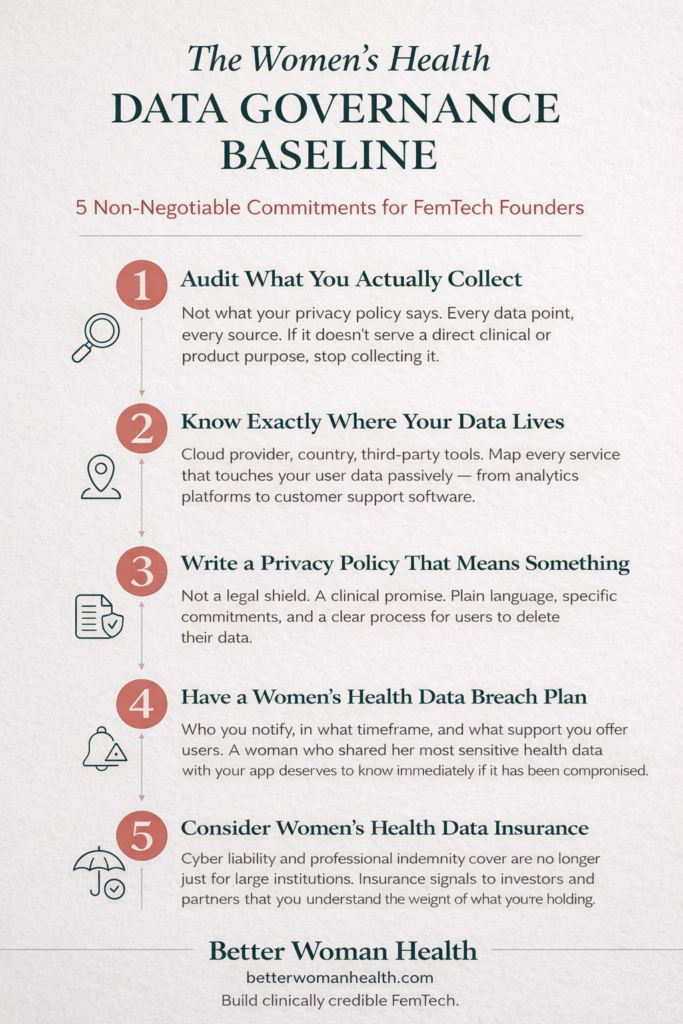
You need clarity, honesty, and five non-negotiable commitments to get this right.
- Audit what you actually collect. List every data point your product captures, not just what your privacy policy says, but what you actually collect. Then ask: Does each one serve a direct clinical or product purpose? If not, stop collecting it. The least risky data is data you never had.
- Know exactly where your data lives. Which cloud provider? Which country? Which third-party tools, analytics platforms, customer support software, and marketing tools have passive access to your user data? Map it. Then decide what’s acceptable.
- Write a privacy policy that actually means something. It should not be a legal shield. It should be a clinical promise written in plain language, telling users specifically what you collect, why, who sees it, and how they can delete it.
- Have a breach plan. A woman who shared her miscarriage data with your app deserves to know immediately if that data has been compromised. Who do you notify? In what timeframe? It’s a clinical responsibility.
- Consider data insurance. Cyber liability and professional indemnity cover are no longer just for large institutions. If your product handles sensitive health data, insurance signals to investors and partners that you understand the weight of what you’re holding.
Due Diligence Starts Here
If you’re an investor, ask the founder: “If your data were subpoenaed tomorrow, what would be exposed?” Ask: “Which third parties have access to your user health data, and what are the contractual
In women’s health specifically, one data scandal can end a company faster than any product failure.
That’s Pillar 7. Next week, we go one level deeper. Stay tuned.
Better Woman Health is published weekly.
Subscribe at betterwomanhealth.com to get it directly in your inbox.
Clinical Credibility Toolkit
The Clinical Credibility Toolkit is a free resource designed for FemTech founders building digital tools for women’s health.
It includes the Clinical Credibility Scorecard, a 28-question assessment that helps you identify gaps in your clinical foundation, evidence strategy, safety architecture, and investor readiness, and the Red Flag Detection Checklist, a 25-question assessment that tells you whether your symptom-tracking app can actually detect and act on medical red flags, not just log them.
If you are preparing to pitch, pursuing healthcare partnerships, or simply want to know where your product stands clinically, start here.
Access the toolkit → app.ayomide.me
Thanks for reading. See you soon!
Dr. Ayomide O.
FemTech Credibility Advisor
Find me on LinkedIn or Book a 1:1 Call