Connected ecosystems
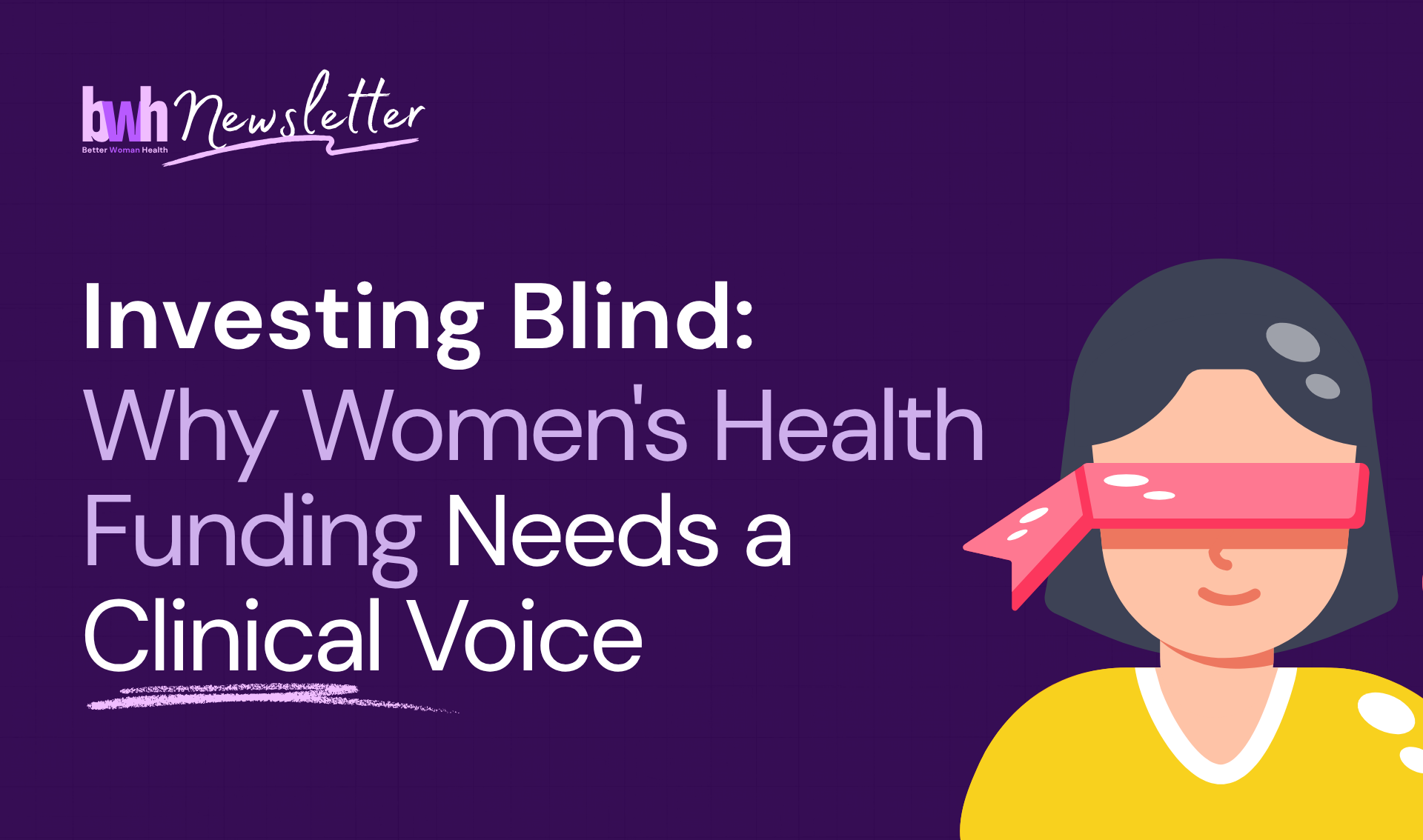
Investing Blind: Why Women’s Health Funding Needs a Clinical Voice
Most investor teams are thorough with the numbers. They dig into the financial model, question the growth assumptions, and map the competition carefully.
But when a founder says “our product is clinically backed,” the conversation continues. Nobody stops to ask what that actually means.
That gap between how carefully commercial claims are examined and how lightly clinical ones are is one of the biggest risks in women’s health investing, and we need to talk about it.
Capital Is Quietly Shaping Women’s Health Standards
The companies that get funded are the ones that scale. The ones that scale shape what consumers trust, what clinicians hear about, and what ecosystems normalize. Which means investment decisions in women’s health are not just commercial decisions. They are, quietly, decisions about what counts as credible.
Every check written in women’s health is also a vote of confidence. And right now, many of those votes are being cast without the knowledge needed to make them well-informed.
This matters more in women’s health than in almost any other sector. Women have spent decades navigating health systems that dismissed their symptoms and minimized their pain. The products being built in this space are, in part, a response to that history. When those products are funded without proper clinical scrutiny, the industry risks reproducing the very problem it set out to solve, just with better branding.
The Need for Scientific Diligence
Women’s health is a space where persuasive storytelling, wellness language, and science-adjacent branding can create a convincing illusion of legitimacy.
Many founders tell the clinical story well, sometimes better than the evidence supports. A pilot study becomes validation, or a cited paper becomes proof. Clinical language fills the gaps that the data has not yet closed.
This is not always intentional. Sometimes founders genuinely believe in what they are building and have not had the clinical scrutiny that would surface the gaps. But the effect is the same: investor teams are evaluating health claims without the clinical perspective needed to fully assess them.
Financial modeling gets rigorous attention. Evidence quality, regulatory risk, and clinical plausibility frequently do not. In a sector where the product is making claims about women’s health, that imbalance has real consequences.
“Clinically Backed” Is Not a Binary
One of the most important things an investor in women’s health can understand is that evidence exists on a spectrum.
There is a significant difference between
- a product supported by a small observational study and one that has been through a randomized controlled trial.
- a claim that has been peer-reviewed and one that merely references a peer-reviewed source.
- a product validated in a clinical setting and one tested in a founder’s beta group of two hundred users.
Most of these differences get collapsed into the phrase “science-backed.”
A clinical voice in an investment process is not looking for pharmaceutical-grade validation at every stage. It is looking for proportionate evidence, honesty about the gaps, and a credible path to stronger validation as the company grows.
Red flags are not always an absence of evidence. Sometimes they are the way evidence is presented, with more confidence than the data actually supports. That distinction requires someone in the room who knows what to look for.
The Cost of Getting It Wrong
In fintech, a product that overpromises loses users. In logistics, it loses contracts. In women’s health, it can delay a diagnosis, reinforce a harmful belief about a woman’s body, or erode the already fragile trust women have in health systems.
When weak claims receive strong funding, capital can unintentionally amplify misinformation at scale. The platform that raises a significant round becomes the one that shapes what a generation of women believe about their health.
That is a different kind of risk, and one that does not stay contained to the company. It affects the entire ecosystem.
What This Actually Requires
Investor teams in women’s health increasingly need clinical reviewers alongside their financial analysts and growth strategists. Not necessarily a full-time Chief Medical Officer, but a clinical voice in the diligence process. Someone who can ask whether the evidence actually supports the claim. Someone who can tell the difference between a founder who understands the limits of their data and one who is hoping nobody looks closely enough to notice.
The women whose health outcomes depend on these products deserve that standard of scrutiny.
And frankly, so do the investors writing the checks.
Better Woman Health is published weekly.
Subscribe at betterwomanhealth.com to get it directly in your inbox.
Clinical Credibility Toolkit
The Clinical Credibility Toolkit is a free resource designed for FemTech founders building digital tools for women’s health.
It includes the Clinical Credibility Scorecard, a 28-question assessment that helps you identify gaps in your clinical foundation, evidence strategy, safety architecture, and investor readiness, and the Red Flag Detection Checklist, a 25-question assessment that tells you whether your symptom-tracking app can actually detect and act on medical red flags, not just log them.
If you are preparing to pitch, pursuing healthcare partnerships, or simply want to know where your product stands clinically, start here.
Access the toolkit → app.ayomide.me
Thanks for reading. See you soon!
Dr. Ayomide O.
FemTech Credibility Advisor
Find me on LinkedIn or Book a 1:1 Call