Understanding the body
PCOS to PMOS: What the Rename Means for Your FemTech Product
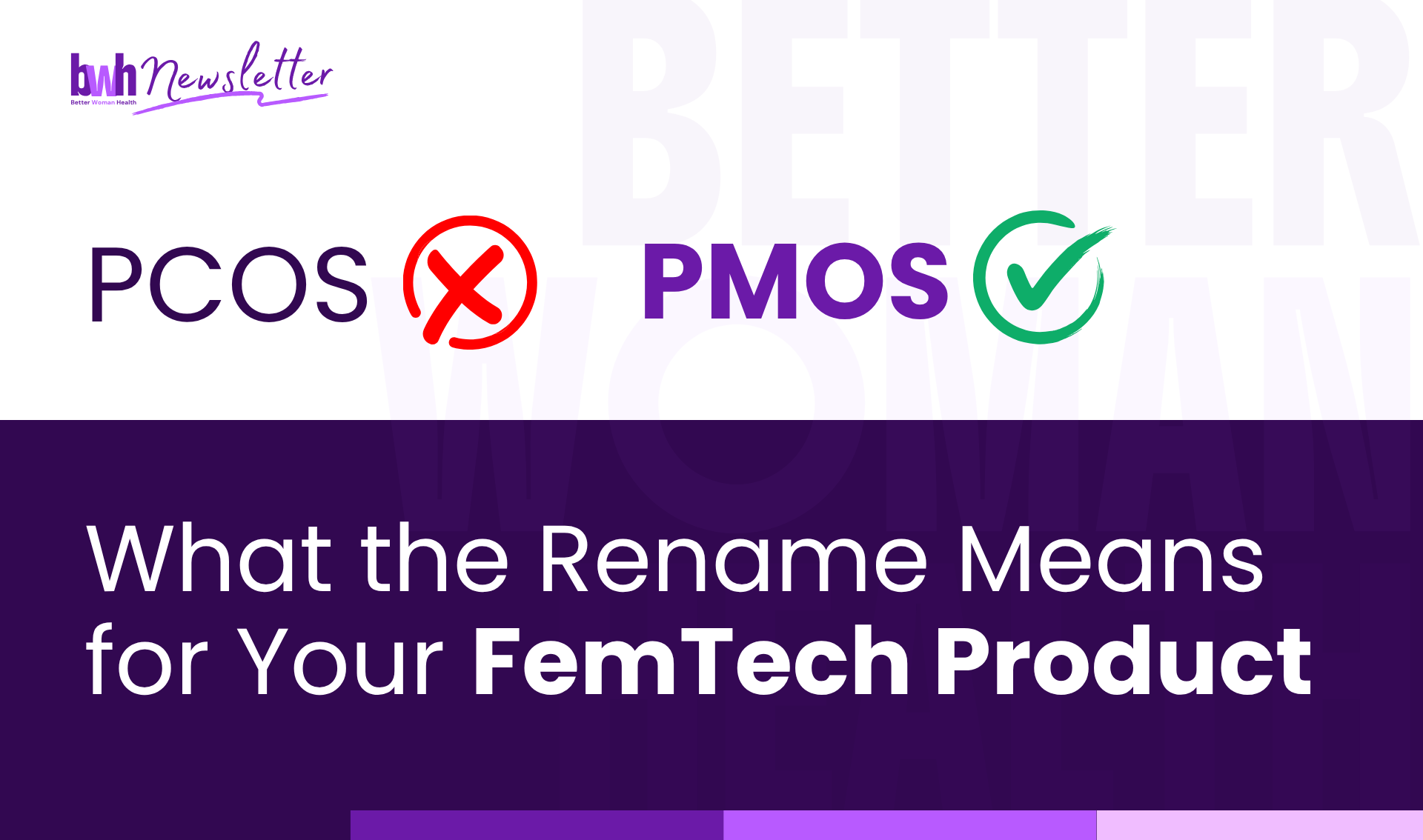
On May 12, 2026, one of the most common hormonal conditions in women got a new name.
Polycystic ovary syndrome (PCOS) is now polyendocrine metabolic ovarian syndrome, or PMOS. The change followed more than a decade of global consultation involving thousands of patients, clinicians, and researchers across 56 organizations, with the findings published in The Lancet. It is one of the largest disease-renaming consensus processes in recent medical history.
If you are building a FemTech product in the women’s hormonal health space, this is not something you can ignore. It is a signal, and it has direct implications for your product, your claims, and your strategy.
Why the Name Changed
The old name had a problem.
“Polycystic ovary syndrome” pointed to ovarian cysts as the defining feature of the condition. But many women with PCOS never develop ovarian cysts at all. What they do experience is a complex set of hormonal disruptions, including irregular cycles, androgen excess, insulin resistance, metabolic dysfunction, cardiovascular risk, and psychological impact, which the old name almost entirely obscured.
For decades, this mismatch between the name and the clinical reality contributed to delayed diagnoses, fragmented care, and stigma. Many women experienced the condition being framed primarily as a fertility issue when it is actually a multisystem endocrine and metabolic condition.
The new name “polyendocrine metabolic ovarian syndrome” aims to better reflect the hormonal complexity, the metabolic dimension, and the ovarian involvement without reducing the condition to something it was never primarily about.
The science of the condition has not changed. The language has finally caught up with what clinicians and patients have known for years.
What This Means for FemTech Founders
- Your terminology needs a transition plan
If your product, app, website, or marketing copy uses the term “PCOS,” you now have a decision to make. The good news is that there is a three-year transition period during which both PCOS and PMOS will be used interchangeably. You are not immediately out of date.
But “we have three years” is not a strategy. Founders who plan deliberately, by updating copy in stages, communicating clearly with their users, and positioning themselves as clinically current, will earn trust during this window. Those who ignore it will eventually look behind.
2. Your clinical framing may be too narrow
Most FemTech products built around PCOS have approached it as a reproductive condition, focused on cycle irregularity, fertility, and ovarian function. The rename is a formal acknowledgement that this framing has always been incomplete.
PMOS is a multisystem condition. It affects insulin signaling, cardiovascular health, metabolic function, mental health, and skin. If your product only tracks or addresses one dimension of this, and if the clinical logic behind it was built around an incomplete picture of the condition, then both your scope and your framework need revisiting.
This is not just a naming issue. It is a product issue.
3. Your clinical team may need to expand
PMOS is not a condition that sits within gynaecology alone. It has endocrine, metabolic, cardiovascular, and psychological dimensions, and a product built to serve it well needs clinical input that reflects that breadth.
This does not mean building a large team. It means asking honestly whether the clinical expertise currently shaping your product covers the full scope of the condition. If your product addresses insulin resistance, mental health, or cardiovascular risk, as it increasingly should, those areas need to be informed by someone qualified to speak to them.
The rename is a prompt to audit not just your terminology but your clinical infrastructure.
4. Search behaviour will shift, and so will your users
This is practical but important. As PMOS enters clinical and public vocabulary, the way women search for information about their condition will likely evolve over time. Building a content and SEO strategy that bridges both terms during the transition is worth starting now.
Beyond the Rename
More than a terminology update, the PCOS to PMOS rename is a formal, global acknowledgement that this condition has been misunderstood, mischaracterized, and inadequately addressed for decades.
For FemTech founders, it is an opportunity to build more accurately, communicate more honestly, and serve the millions of women affected by this condition with the clinical depth they have always deserved.
Your product needs to move with the science.
Better Woman Health is published weekly.
Subscribe at betterwomanhealth.com to get it directly in your inbox.
Clinical Credibility Toolkit
The Clinical Credibility Toolkit is a free resource designed for FemTech founders building digital tools for women’s health.
It includes the Clinical Credibility Scorecard, a 28-question assessment that helps you identify gaps in your clinical foundation, evidence strategy, safety architecture, and investor readiness, and the Red Flag Detection Checklist, a 25-question assessment that tells you whether your symptom-tracking app can actually detect and act on medical red flags, not just log them.
If you are preparing to pitch, pursuing healthcare partnerships, or simply want to know where your product stands clinically, start here.
Access the toolkit → app.ayomide.me
Thanks for reading. See you soon!
Dr. Ayomide O.
FemTech Credibility Advisor
Find me on LinkedIn or Book a 1:1 Call