Clinical credibility
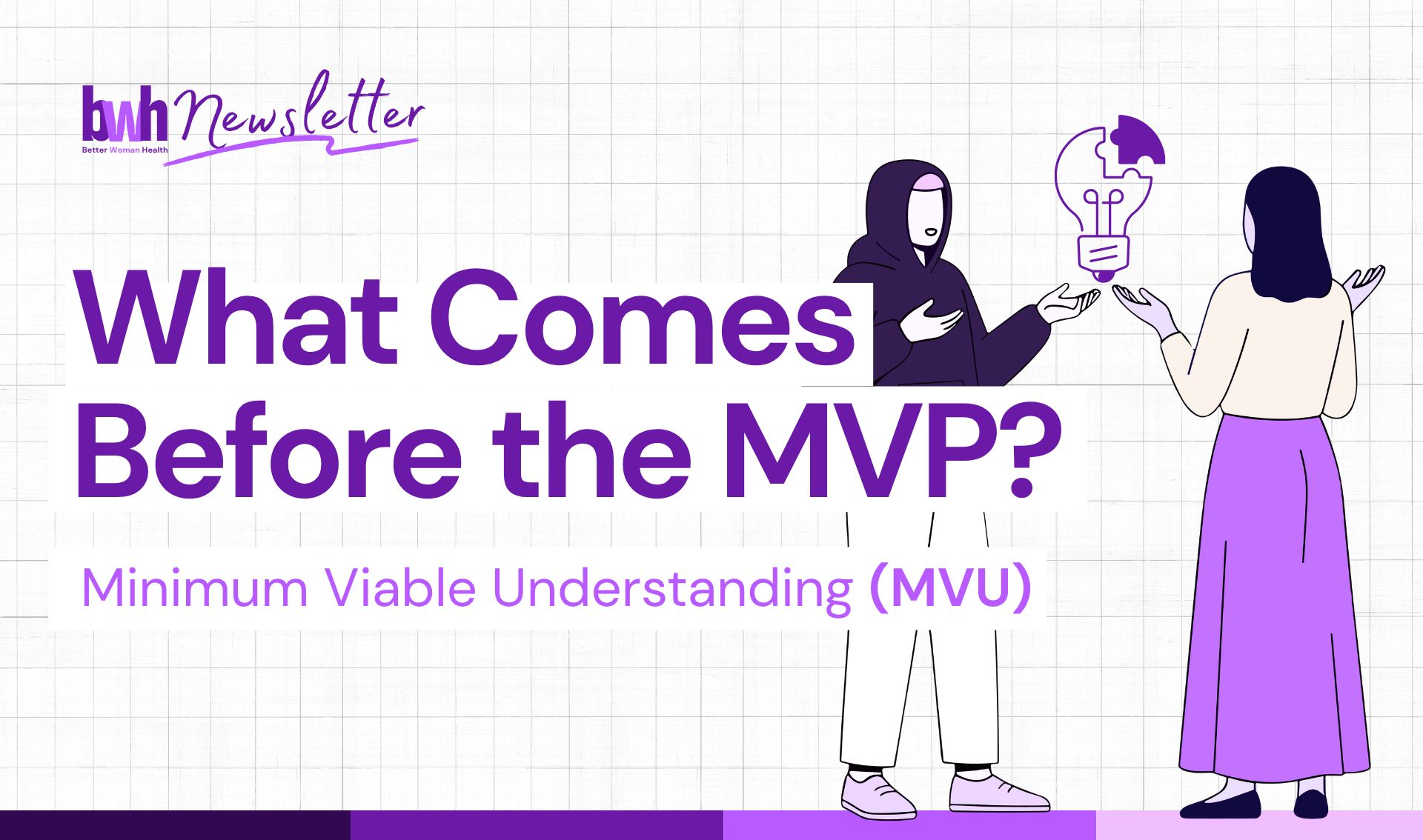
What Comes Before the MVP?
Everyone talks about building fast.
The startup world has made speed a virtue, and in many industries, that works. They want you to build fast, ship fast, and iterate fast.
But in women’s health, moving fast without the right foundation does not just waste money; it wastes trust. And trust, once lost with women who have already been let down by healthcare systems, is very hard to earn back.
So before we talk about your MVP, let’s talk about what comes before it.
Why the MVP is Not Your First Step
The sequence many founders use is:
Idea → MVP → Users → Growth
It feels logical. You spot a problem, you build something, you find your users, and you scale. In women’s health, this sequence might get you into trouble.
The sequence that actually works looks more like this:
Problem → Evidence → User Insight → Clinical Input → MVP
The MVP is not your first step but the result of several earlier steps. And skipping those steps is why so many women’s health products launch with compelling branding, weak science, and confused users.
What you need before you build: Minimum Viable Understanding
Before you have a Minimum Viable Product, you need what I call “Minimum Viable Understanding,” a clear, evidence-informed grasp of the problem you are solving, the women you are solving it for, and whether your solution is actually grounded in science.
1. Is this actually a specific problem?
“Women’s health is underserved” is not a problem statement. It is a category.
The question is: what specific problem are you solving? If your answer is menopause, go deeper. Are you solving sleep disruption? Hot flashes? Access to care? Workplace invisibility? Hormonal symptom tracking? The more precisely you can name the problem, the better everything else becomes, including your product, your claims, your marketing, and even fundraising conversations.
2. Do women actually recognize this problem?
A clinically important problem is not always a problem women know they have. This is especially true in African markets, where many founders discover that before they can sell a solution, they first need to educate their users that a problem exists at all.
This is not a reason to walk away from a market. It is a reason to build user education into your product strategy from the beginning, not as an afterthought.
3. What are women currently doing instead?
Your biggest competitor is probably not another startup.
Understanding what women are already doing tells you what your product needs to offer that those options do not, and it keeps you from building something that solves a problem women have already quietly solved on their own.
4. What does the science actually say?
This is where FemTech most commonly goes wrong.
The product idea sounds compelling, the founder is passionate, and the pitch is polished. But the underlying science is thin, misrepresented, or simply does not support the claims being made. Before you build, ask: what evidence exists for this intervention? What claims could legitimately be made down the line? What claims could never be made? These questions will shape your product design, your regulatory pathway, and your investor conversations, whether you answer them now or are forced to answer them later.
5. Who else needs to trust this product?
Women’s health products rarely succeed on user enthusiasm alone. Depending on your category, you may also need the trust of clinicians who could refer patients, employers who could offer your product as a benefit, insurers who could cover it, or regulators who will determine what you are permitted to say.
Trust requirements should influence your MVP design from day one, not be retrofitted after launch.
Build Small. Scale Fast
Doing all of this groundwork does not slow you down. It protects you from building the wrong thing confidently.
The founders who move fastest in women’s health are almost always the ones who spent the most time, early on, making sure they were solving the right problem. They asked hard questions before they wrote a single line of code. They talked to clinicians before they talked to developers. They understood their market before they entered it.
The goal of a pre-MVP stage is not to build something. It is to understand something.
And in women’s health, where the stakes are high, the science is complex, and the women you are serving have often been let down before, understanding is not optional. It is the foundation everything else is built on.
Better Woman Health is published weekly.
Subscribe at betterwomanhealth.com to get it directly in your inbox.
Clinical Credibility Toolkit
The Clinical Credibility Toolkit is a free resource designed for FemTech founders building digital tools for women’s health.
It includes the Clinical Credibility Scorecard, a 28-question assessment that helps you identify gaps in your clinical foundation, evidence strategy, safety architecture, and investor readiness, and the Red Flag Detection Checklist, a 25-question assessment that tells you whether your symptom-tracking app can actually detect and act on medical red flags, not just log them.
If you are preparing to pitch, pursuing healthcare partnerships, or simply want to know where your product stands clinically, start here.
Access the toolkit → app.ayomide.me
Thanks for reading. See you soon!
Dr. Ayomide O.
FemTech Credibility Advisor
Find me on LinkedIn or Book a 1:1 Call